
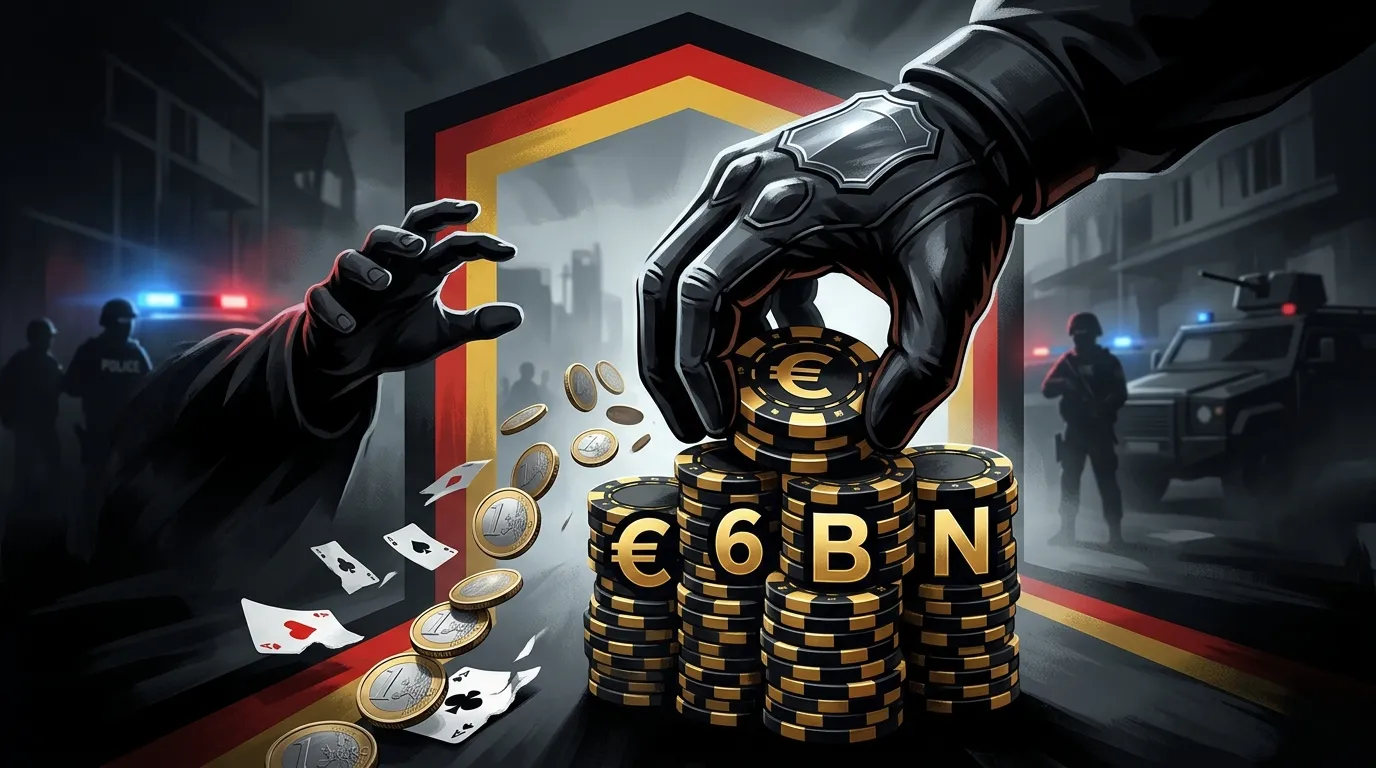


German Authorities Bust €6bn Illegal Gambling Operation
In one of the most significant European enforcement actions this year, a massive German gambling crackdown has brought down a sophisticated illegal gambling ring. Following a three-year investigation, authorities raided eleven locations, uncovering an unlicensed online casino that handled almost €6 billion in stakes between 2021 and 2023.
The coordinated operation involved over 100 officers from Frankfurt’s Prosecutor’s Office, the Frankfurt Tax Office, the North Rhine-Westphalia Counter-Financial Crime State Office, and Frankfurt police. Authorities have identified five suspects in connection with the ring. The raids resulted in the seizure of assets valued at approximately €82 million, including luxury vehicles and frozen bank accounts.
At least one individual has been arrested and is also facing charges for tax evasion amounting to an estimated €77.6 million. This bust follows a recent warning from the Financial Action Task Force (FATF), which highlighted online gambling as a high-risk sector for money laundering and a threat to the German economy.
Black Market Concerns Amplify in Germany
The scale of the operation has prompted industry bodies to question official estimates of Germany's unregulated market. The German Sports Betting Association (DSWV) praised the authorities but expressed alarm at the figures involved.
“Nearly €6bn in wagers over two-and-a-half years in a single investigation must prompt a critical review of previous assumptions about the size of the black market. If even a single case reveals such proportions, it inevitably raises the question of whether previous black market estimates realistically reflect the actual scope of the illegal market.” - Mathias Dahms, DSWV President
Germany currently suffers from one of Europe's lowest player channelisation rates. Projections from H2 Gambling Capital in 2025 indicated that channelisation for licensed online slots was only between 22% and 25%, with fears it could drop to 20% by 2030 without significant reforms.
North Africa's Online Betting Licensing Gap Persists
While Germany cracks down on its black market, several North African nations are struggling to establish any form of regulated online betting for private operators. The recent agreement for Lottomatica to acquire Cirsa, which operates four Moroccan casinos, underscores a stark divide between the regulated land-based sector and the prohibited online space in the region.
Countries like Morocco, Tunisia, and Egypt have focused on enforcement and prohibition rather than creating a licensing framework for private online betting. This has created a significant North Africa online betting licensing gap, leaving a sizable market unregulated and untaxed.
| Country | Regulatory Status | Recent Actions |
|---|---|---|
| Morocco | State monopoly (MDJS) for sports betting. No private online licenses. | MDJS attempted to force ISPs to block 19 offshore sites, but a court order was overturned on appeal. MDJS claims illegal betting costs the state MAD700m annually. |
| Tunisia | State monopoly (Promosport) for sports betting. | Two competing bills are stalled in parliament: one to criminalize online gambling, another to modernize the state monopoly. No licensing path for private operators has emerged. |
| Egypt | No online licensing framework. Laws focus on physical venues for non-Egyptians. | Government is pursuing enforcement, freezing e-wallets and blocking betting apps. Proposed bills to criminalize online betting have not passed. |
PMU Restructuring Plan Meets Union Resistance in France
In France, the state-owned horseracing operator Pari Mutuel Urbain (PMU) is facing internal hurdles with its new corporate strategy. A significant PMU restructuring plan, designed to modernize the business, has been rejected by one of the four major trade unions involved.
The plan, introduced by new CEO Cyrille Giraudat, involves cutting 128 positions while creating 81 new ones, for a net loss of 47 jobs. The French Democratic Confederation of Labour (CFDT) refused to sign the agreement, citing “commercial contradictions.” The union argues the changes undermine the regional sales teams responsible for managing PMU's network of 14,000 retail partners, which are vital for attracting new customers.
PMU has struggled with an ageing customer base and saw returns to racing stakeholders decline from €835m in 2024 to €802m in 2025. The restructuring is part of the Pacte PMU 2030 strategy, which includes modernizing its product offerings with the new Kambi-powered PMU Play app.
New Tool Launched to Track iGaming Affiliate Placements
On the technology front, iGaming analytics platform Blask has launched a new feature called Blask Affiliates. This dashboard is designed to automatically map every operator brand across every affiliate website, providing a new level of market intelligence.
The affiliate marketing tool finds affiliate sites, identifies which brands they promote, and logs the exact position of each brand daily, complete with a dated screenshot for verification. The service aims to provide actionable data for both operators and affiliates.
Key Features of Blask Affiliates:
- For Operators: Users can track their brand placements, discover new high-traffic affiliate partners, and monitor competitors' campaign activity in near real-time.
- For Affiliates: Users can analyze what brands competitors are promoting, identify which operators are actively expanding their affiliate programs, and scout new markets.
The platform is now live, starting with coverage of 315 affiliate sites in Brazil, with plans to expand to more countries over time. This new iGaming analytics service offers a transparent way to measure brand strength and campaign reach in the affiliate space.


